

Box Domus: Frequently Asked Questions
Renovations, Extensions & Free-Standing Rooms in Melbourne
Planning a renovation, home extension, or architectural building project can raise many questions. Every home is different, and every project comes with its own challenges.
Below you’ll find detailed answers to common questions about house renovations, home extensions, architectural building, planning permits, and free-standing rooms in Melbourne.
This guide will help you better understand the building process, costs, timelines, and design considerations involved in improving your home.
Jump to: About | Permits | Plans & Design | Free-Standing Room | House Extension | House Renovation | Kitchen Renovation | Bathroom RenovationAbout Box Domus
-
Box Domus is a Melbourne-based building company specialising in high-quality home renovations, house extensions, and architectural building projects.
Our work focuses on improving the function, layout, and design of existing homes, particularly in Melbourne’s inner and established suburbs.
We provide services including:
Architectural renovations
House extensions
Kitchen renovations
Bathroom renovations
Structural home upgrades
Free-standing backyard rooms
Architectural drawings and design
Town planning applications
Every project is approached with a focus on good design, quality construction, and careful attention to detail.
-
Many of the homes we work on are period or character homes common across Melbourne, including:
Victorian terraces
Edwardian homes
Californian bungalows
Mid-century houses
Contemporary homes needing redesign or extension
These homes often require structural upgrades, improved layouts, and modern living spaces while maintaining their original character.
-
Yes. We are Registered Building Practitioners in Victoria. This is critical for your insurance and peace of mind. We don't just "manage" the project; we take full legal and professional responsibility for the build.
-
We are both. Our director is a lead architect with over 30 years of experience, and he personally oversees the design of every project. We also have a dedicated team of support staff—including designers and compliance specialists—who work together to ensure your vision is both beautiful and buildable.
-
It eliminates the "middleman" problem. Usually, an architect designs a home and then a builder tells you it’s too expensive. Because we are architects who also build, we know exactly what materials cost and how long labour takes while we are still in the drawing phase. You get high-end design with a realistic price tag.
-
Most people hire an architect and then a builder separately, which often leads to budget blowouts and design friction. At Box Domus, we are a "one-stop-shop." We handle everything—architectural design, council permits, and the actual construction. This means you get a single point of contact and a design that is actually buildable within your budget.
We offer a true "Concept to Completion" service:
Architectural Design: Custom plans tailored to your block.
Permits & Approvals: We handle all Council and Building Permit applications.
Project Management: Full oversight of every trade and timeline.
Construction: High-end architectural building and extensions.
-
Box Domus works mainly in Melbourne’s inner and established suburbs, where renovations and extensions are often required to modernise older homes.
Common project locations include:
Fitzroy
Fitzroy North
Northcote
Brunswick
Carlton
Collingwood
Richmond
Clifton Hill
Thornbury
Hawthorn
Kew
Balwyn
South Yarra
Prahran
Toorak
St Kilda
Yarraville
Projects outside these areas may still be considered depending on the size and complexity.
-
A planning permit may be required for projects involving:
Home extensions
Heritage properties
Significant structural changes
Secondary dwellings
Boundary setbacks
Every council in Melbourne has different planning requirements, so early consultation is important.
-
In 2026, the timeline depends on your project’s complexity. For a standard architectural extension or new home in a residential zone, expect 3 to 6 months. While the law technically gives councils a 60-day window, the "clock" often pauses for requests for further information (RFI) or the mandatory 14-day public advertising period.
The process includes:
Preparing drawings and documentation
Submitting an application to council
Council review and feedback
Approval or requests for changes
Clear documentation improves the chances of smooth and faster approval.
-
Some minor works—like small extensions, fences, or even certain two-dwelling developments—can qualify for VicSmart. This is a streamlined process where the council must decide within 10 business days. As your designers, we identify early if your project fits these criteria to save you months of waiting.
-
If a permit is refused, we don't just walk away. Because our Director is an architect with extensive compliance experience, we can often negotiate with the council planners to amend the design and reach a "Notice of Decision to Grant a Permit." If necessary, we can also represent the project at VCAT (Victorian Civil and Administrative Tribunal).
-
Does an architect-led firm speed up the permit process? Yes. Traditional builders often outsource the design, which leads to back-and-forth delays. At Box Domus, we handle the architecture, compliance, and construction under one roof. We submit "lodgement-ready" packages that include all soil reports, shadow diagrams, and site surveys upfront, which prevents the council from "stopping the clock" due to missing info.
Planning Permits
-
Every project is led by our Director, a lead architect with over 30 years of experience in the Melbourne construction industry.
You aren't just getting a "draftsman" version of a plan; you are getting architectural oversight from the first sketch. Our supporting design team then builds out the technical details to ensure the project is ready for construction.
-
We specialize in a clean, minimalist style often referred to as "Box Modern." It’s characterized by bold geometric shapes, flat or squillion rooflines, and a mix of raw, high-performance materials like concrete, steel, and timber.
It’s about creating a striking architectural statement that is also highly functional.
-
Absolutely. We believe you should be able to "walk through" your extension before a single brick is laid.
We provide 3D renderings and architectural visualizations so you can see exactly how light, space, and materials work together on your specific block.
-
That is our specialty. Many of our projects are in inner-Melbourne suburbs where space is at a premium. We use "smart footprint" design to maximize natural light and living space, even on the tightest blocks, while ensuring we remain compliant with local ResCode requirements.
-
Our plans are "construction-ready." This means they include everything needed for both Council approval and the build itself:
Site plans and floor layouts.
Elevations and sections.
Detailed material specifications.
Shadow diagrams and overlooking assessments (for planning compliance).
Electrical and plumbing layouts.
Architectural Plans & Design
The Box: Free-Standing Rooms & Studios
-
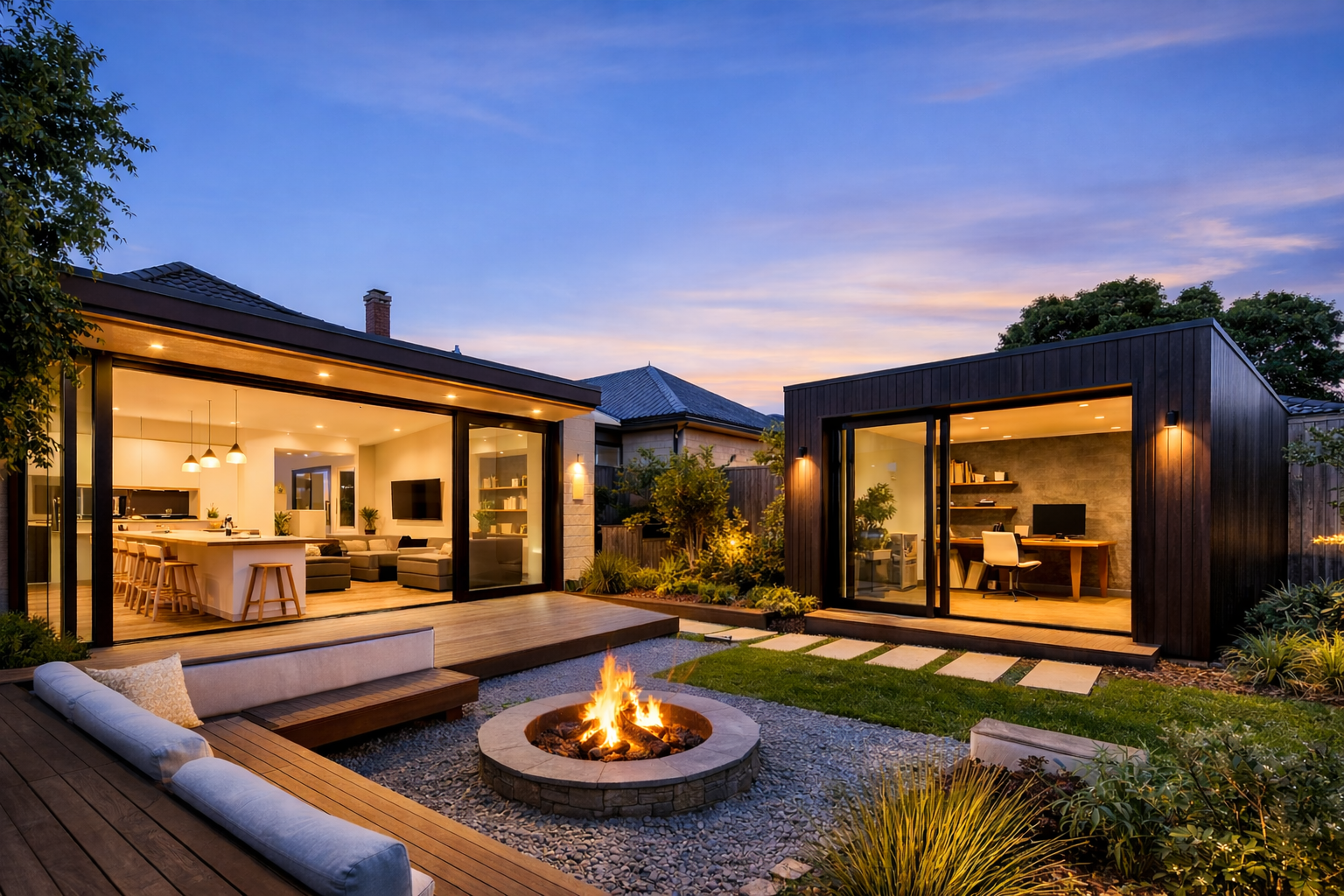
The Box is our signature free-standing architectural room. It is a completely detached, self-contained structure designed to sit in your backyard or on your property.
Unlike a basic "shed" or cheap kit cabin, The Box is a high-performance building designed by our lead architect to the same standards as a luxury home.
Unlike an extension, it is not attached to the main house.
These structures provide additional living space while maintaining the existing home layout.
-
The beauty of The Box is its flexibility. Our clients typically use them as:
Home offices
Art studios
Guest accommodation
Teenage retreats
Music rooms
Gym spaces
Pool houses
Remote working spaces
They are ideal for homeowners who need extra space without major structural changes to the house.
-
In Victoria, most permanent free-standing structures require a building permit. If the room includes a kitchen or is over a certain size, you may also need a planning permit.
Because we are an architect-led firm, we handle the entire approval process, ensuring your Box is 100% legal and compliant with local council regulations.
Factors that affect approvals include:
Building size
Distance from boundaries
Zoning regulations
Heritage overlays
Building height
Proper planning ensures the structure meets local council regulations and building standards.
-
Absolutely. We build with the materials of your choice and design around your specific budget.
While we love the look of raw concrete and Shou Sugi Ban for these studios, we can finish The Box in any material that complements your existing home or garden.
-
Yes. These aren't "glorified sheds." Every Box is fully insulated and designed for year-round comfort.
Home Extensions Melbourne
-
A home extension increases the size of a house by adding new living areas.
Extensions allow homeowners to stay in their existing location while gaining more space.
Common types include:
Rear extensions
Ground-floor extensions
First-floor additions
Side extensions
Open-plan living expansions
Extensions are particularly popular in Melbourne suburbs where block sizes are limited but property values are high.
-
Many homeowners choose to extend because it allows them to:
Stay in their current neighbourhood
Avoid the cost of buying and selling property
Customise their home to suit their lifestyle
Increase property value
Improve functionality and comfort
A well-designed extension can transform an older home into a modern living space without losing its character.
-
It often comes down to your block and your budget. If you love your current location or have a heritage home with character, an architectural extension is a great way to add modern living space without losing your backyard or the original charm.
We’ll assess your site to see if a ground-floor "bump-out" or a second-storey addition gives you the best return on investment.
-
We can. While we are known for our "Box Modern" architectural style, we build with materials of your choice. If you want the extension to blend seamlessly with your existing brickwork or timber cladding, we can source matching materials.
If you prefer a bold, modern contrast using steel and glass, we can design that too.
-
Because we are an architect-led firm, we design with your budget in mind. Costs vary depending on the complexity (e.g., adding a second storey is generally more expensive than a ground-floor extension).
-
Yes. Adding a level requires a deep understanding of your existing home’s footings and load-bearing walls.
Our team handles all the structural engineering and compliance checks to ensure your new extension is safe, stable, and meets all Victorian building regulations.
-
In the Melbourne market, adding a bedroom or a second living area is one of the most effective ways to increase equity.
We focus on "high-yield" designs—maximizing natural light and usable floor area—to ensure your extension adds more value to the home than it costs to build.
-
The total timeline depends on several factors.
Design and planning stage - 2–6 months depending on complexity.
Council approvals - If required, planning permits can take 2–4 months or longer.
Construction stage - Construction typically takes 3–6 months, depending on project size.
Clear planning at the beginning helps keep the project efficient and predictable.
-
A home renovation involves upgrading or redesigning part or all of an existing house.
Renovations can include:
Improving the layout of a home
Updating kitchens and bathrooms
Removing walls to create open living areas
Upgrading structural elements
Modernising interiors
Improving natural light and flow
Many homeowners in Melbourne renovate to adapt older homes to modern lifestyles while preserving their architectural character.
-
The most common renovation projects include:
Kitchen renovations- Modernising kitchens with improved layouts, storage, and appliances.
Bathroom renovations- Updating outdated bathrooms with new fixtures, waterproofing, and improved functionality.
Open-plan living renovations- Removing internal walls to create kitchen, dining, and living spaces that connect to outdoor areas.
Whole-home renovations- Transforming the entire house, often including structural upgrades and layout changes.
-
Yes.
Many homes across Melbourne fall within heritage overlays, which means renovations must respect the historical character of the property.
Renovating a heritage home often involves:
Working with architects and heritage consultants
Preparing council documentation
Designing sympathetic extensions
Preserving original façade elements
The goal is to modernise the home while retaining its architectural identity.
-
Your home should reflect your style. While we are known for our love of raw materials like concrete, steel, and timber, we build with the materials of your choice.
We provide professional guidance on what works best for durability and performance, but the final selection—from the cladding to the fixtures—is entirely up to you.
-
We design with your budget in mind from the first sketch. Because we are an integrated design-and-build firm, we don't guess costs—we know them.
We can suggest "high-impact" materials that give you an architectural look without the custom price tag, ensuring we maximize every dollar of your investment.
-
This depends on the scale of the work. For major structural renovations or second-storey additions, it is often safer and faster if the site is clear.
However, for smaller rear extensions, we can often stage the build to minimize disruption. We’ll discuss the timeline and logistics with you during the planning phase.
-
Yes. Renovating older Melbourne homes often reveals "surprises" once walls are opened up.
Our team handles all structural engineering assessments and heritage compliance to ensure your renovation is rock-solid and meets current Victorian building standards.
House Renovation Melbourne
Kitchen Renovations Melbourne
-
A kitchen renovation involves redesigning and upgrading the kitchen space to improve layout, functionality, and appearance.
A typical kitchen renovation may include:
Removing existing cabinetry and fixtures
Installing new cabinets and storage solutions
Upgrading benchtops and splashbacks
Installing new appliances
Improving lighting and electrical layout
Updating plumbing and sinks
Improving the overall layout of the kitchen
Many Melbourne kitchen renovations also include opening the kitchen into a larger living area to create modern open-plan spaces.
-
The cost of a kitchen renovation in Melbourne can vary significantly depending on:
Kitchen size
Materials and finishes
Appliance selection
Structural changes
Custom cabinetry
Plumbing and electrical work
A small kitchen upgrade may involve replacing cabinetry and finishes, while a larger renovation may include layout changes or structural modifications.
Because every project is unique, costs are best determined through a project consultation and design process.
-
A standard structural kitchen renovation usually takes between 4 to 8 weeks of on-site work, depending on the complexity of the project. This timeline depends on the complexity of the plumbing and electrical moves.
The full process may include:
Design and planning
Ordering cabinetry and materials
Demolition of the existing kitchen
Plumbing and electrical work
Cabinet installation
Benchtop installation
Appliance installation and finishing
Because our Director and design team oversee the project, we ensure all trades are coordinated perfectly to avoid unnecessary downtime.
-
Absolutely. We build with the materials of your choice. Whether you want raw concrete benchtops, custom timber cabinetry, or high-end stone finishes, we work with your aesthetic.
We also design around your specific appliance choices to ensure the layout is functional and looks integrated.
-
We believe great design shouldn't be a guessing game. By designing with your budget in mind, we can suggest where to invest in "hero" materials (like a feature splashback or island bench) and where to save on more functional elements.
Because we are the builders, we provide a fixed-price contract so you know exactly what the renovation costs before we start.
-
If your kitchen renovation involves structural changes or an extension to the building "envelope," you will likely need a building permit.
We handle all the paperwork, compliance checks, and permits required by Melbourne councils, so you don't have to navigate the red tape yourself.
-
It’s a look that prioritizes clean lines, hidden storage, and raw materials. We often use a mix of matte black steel, natural timber, and concrete to create a kitchen that feels more like a piece of architecture than just a utility room.
-
Yes.
Many homes in Melbourne’s inner suburbs were built decades ago and often require kitchen upgrades to suit modern living.
Kitchen renovations in older homes may involve:
Updating plumbing and electrical systems
Improving structural support
Opening up enclosed rooms
Increasing natural light
Connecting the kitchen to living areas or outdoor spaces
The goal is to create a modern kitchen that complements the character of the home.
-
A well-designed kitchen renovation is often one of the most valuable improvements a homeowner can make.
A new kitchen can:
Improve the functionality of the home
Enhance visual appeal
Increase buyer interest
Add overall property value
Many real estate professionals consider the kitchen to be one of the most influential spaces when selling a home.
-
Yes.
Many homeowners choose to renovate the kitchen as part of a larger home extension project.
This often allows the kitchen to become the central open-plan living space of the home, connecting to dining areas and outdoor entertaining zones.
Combining a kitchen renovation with an extension can significantly improve the overall layout of a house.
Bathroom Renovations Melbourne
-
We do both. Our Director is the lead architect, so we approach your bathroom as a structural and aesthetic project.
We don't just "replace the vanity"; we look at how to optimize the layout, move walls if needed to create more space, and ensure the lighting and ventilation are architecturally integrated.
-
A bathroom renovation usually involves removing the existing bathroom and rebuilding the space with updated fixtures, finishes, and layout improvements.
Typical bathroom renovation work includes:
Removing existing tiles, fittings, and cabinetry
Updating plumbing and drainage
Installing new waterproofing
New floor and wall tiling
Installing a shower, bath, vanity, and toilet
Upgrading lighting and ventilation
Installing mirrors, storage, and accessories
Many bathroom renovations also focus on improving layout and storage so the space feels larger and more functional.
-
Yes. We build with the materials of your choice. Whether you want a raw concrete sink, handmade Zellige tiles, or aged brass tapware, we work with your style.
We also design with your budget in mind, helping you select high-performance materials that look premium without unnecessary costs.
-
Bathroom renovation costs can vary depending on several factors, including:
Bathroom size
Materials and finishes
Plumbing and electrical work required
Structural changes
Custom cabinetry or stone surfaces
A simple bathroom update may involve replacing fixtures and tiles, while a full renovation may include reconfiguring the layout and upgrading plumbing systems.
A consultation helps determine the most suitable approach and budget for your specific bathroom renovation project.
-
The construction stage of a bathroom renovation typically takes 3 to 5 weeks, depending on the size of the bathroom and the complexity of the work.
The process usually includes:
Demolition of the existing bathroom
Plumbing and electrical preparation
Waterproofing installation
Tiling of floors and walls
Installation of fixtures and cabinetry
Final fittings and finishing details
Proper scheduling and planning help ensure the renovation progresses smoothly.
-
Yes.
Many bathroom renovations involve redesigning the layout to make better use of the available space.
Common layout improvements include:
Creating walk-in showers
Repositioning vanities or toilets
Adding built-in storage
Improving lighting and ventilation
Making small bathrooms feel more open
A well-planned layout can significantly improve both functionality and comfort.
-
It depends on the scope. If you are keeping the layout exactly the same, you generally don’t need a permit. However, if we are moving walls, relocating the toilet/drainage, or adding new windows, a building permit is required by law.
Because we are Registered Building Practitioners, we manage all these approvals and compliance certificates for you.
-
Yes.
Bathrooms are one of the most important spaces buyers evaluate when purchasing a home.
A well-designed bathroom renovation can:
Improve the overall appeal of a property
Increase comfort and functionality
Add perceived value to the home
Help the property stand out in the market
Modern, well-built bathrooms often make a strong impression on potential buyers.
-
It is the most important part of the build. Poor waterproofing is the leading cause of structural damage in Melbourne homes.
We use high-grade waterproofing systems that meet or exceed Australian Standards, and we provide a Compliance Certificate upon completion for your peace of mind and future home resale value.
Ready to start your project?
Architecture, Permits, and Construction—all handled by one team.
Whether you are looking for a modern extension, a structural renovation, or a free-standing studio, we’re here to make the process straightforward. Skip the "architect-vs-builder" headache and work with a team that understands both the design and the dirt.